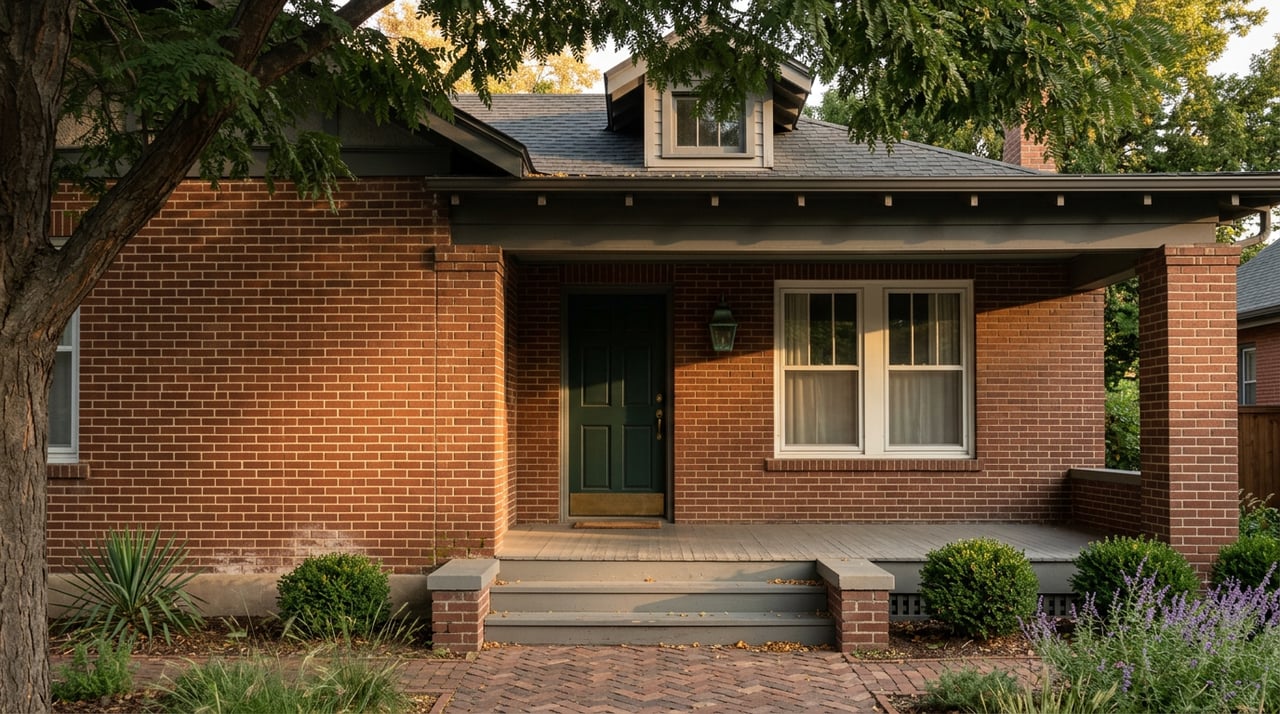
The Radon Paragraph Every Grand Junction Contract Now Contains
September 3, 2026
September 3, 2026
Somewhere in the stack of paperwork at your next Grand Junction closing, in bold capital letters that are easy to skim past, sits a warning about a gas you can't see, smell, or taste. It's not an optional add-on your agent tacked on to be thorough. Since August 7, 2023, Colorado law has required this exact language in every residential sales contract in the state, and in Mesa County it's not boilerplate you can safely ignore. The geology under this valley makes it relevant more often than not.
Here's the sentence that now sits in your contract, drawn directly from the statute:
"The Colorado Department of Public Health and Environment strongly recommends that all home buyers have an indoor radon test performed before purchasing residential real property and recommends having the radon levels mitigated if elevated radon concentrations are found."
That single line, mandated by SB23-206, is the reason nearly every Grand Junction purchase agreement now includes a radon contingency as a matter of course rather than an exception. The thesis worth sitting with is this: in most Colorado markets, a radon clause is a formality that rarely gets triggered. In Grand Junction, it gets triggered often enough that treating it as routine, rather than alarming, is the accurate read.
Under SB23-206, the seller of any residential property in Colorado must disclose whatever they know about the home's radon history: whether a test has been done, what it showed, and whether a mitigation system was ever installed. The Colorado Division of Real Estate's own broker advisory spells out the contract language brokers are required to use, and it requires the seller to hand over the state health department's radon brochure at the same time. None of this is optional for the seller or discretionary for the agent. It's baked into the transaction now, the same way a lead paint disclosure is baked into the sale of a pre-1978 home nationally.
What the law does not do is mandate testing or mitigation. It mandates disclosure and a strong recommendation. Whether a test actually happens, and what happens if it comes back high, is still a matter of negotiation between buyer and seller. That's the part that plays out differently here than it does in, say, a low-radon market on the Front Range.
The EPA's Map of Radon Zones places Mesa County in Zone 1, the highest designation, meaning the predicted average indoor screening level for the county exceeds 4 picocuries per liter, the same threshold at which the EPA recommends fixing a home. Local radon contractors working the Grand Junction market put average indoor readings anywhere from the low 6s up into the 8 pCi/L range, all of it above that action level. Statewide, the Colorado Department of Public Health and Environment's own tracking data on tests conducted between 2005 and 2022 found that just under half came back above 4.0 pCi/L.
Put those two facts together and the takeaway isn't "be afraid of radon." It's that an elevated reading on your test is closer to the expected outcome than the surprising one. If you're buying or selling here, the useful question isn't "will this house have a radon problem." It's "what happens next when it does," because the odds favor that outcome more than they would in most of the country.
Where a Grand Junction property sits on the age spectrum changes what that "what happens next" actually looks like, and this is where the construction side of the equation matters more than the legal side.
| Older downtown home (pre-1960s construction, the kind found in and around the North Seventh Street Historic Residential District) | New subdivision build (built to current radon-resistant standards) | |
|---|---|---|
| Foundation type | Aging crawlspace or basement with settled cracks, sometimes stone or rubble footings | Poured slab with a gas-permeable layer and vent stack installed during construction |
| Typical first test | Often elevated, since gas has more entry points through age-related gaps | Frequently closer to baseline, since the passive venting is already routing gas outside |
| What mitigation involves | Retrofitting an active fan system, sealing foundation cracks, sometimes penetrating a slab that was never designed for it | Often just adding a fan to the vent stack that's already there, no new drilling required |
| Realistic timeline | Contractor assessment plus install can run one to two weeks depending on scheduling | Faster in most cases, since the physical infrastructure exists before the fan goes in |
A home inside a designated historic district doesn't need special sign-off from the city's Historic Preservation Board to add interior mitigation equipment. The Board's Certificate of Appropriateness process is aimed at alterations visible from the street, not mechanical systems in a crawlspace. The one thing worth checking before work starts is where the new exhaust vent will terminate on the exterior, since a visible pipe run on a designated structure is the kind of detail that can draw questions later if it wasn't installed cleanly.
For a buyer under contract on a Grand Junction home, the radon clause tends to play out in a predictable sequence:
None of this is unique to Grand Junction as a legal process. What's unique is how often it actually gets used, because the underlying geology means a meaningful share of local homes will need it.
Does an elevated radon reading kill a Grand Junction deal? Rarely. Given how common elevated readings are here, most buyers and sellers treat it as a repair item to negotiate, not a reason to walk. The exception is when a seller refuses to address a high reading or credit for one, which can stall a deal the same way any other unresolved repair dispute would.
If a house is brand new, do I still need to test it? Yes. Builders using radon-resistant techniques install a gas-permeable layer, sheeting, a vent pipe, and a junction box for a future fan, but that passive system reduces risk rather than guaranteeing a low reading. The only way to know the actual number is to test it, and the disclosure requirement in the contract applies regardless of the home's age.
Will adding a mitigation fan cause problems with a historic designation? Generally no, since the Historic Preservation Board's review authority covers exterior alterations to designated structures, not interior mechanical work. The detail worth confirming ahead of time is where the vent terminates outside the home, since that's the one visible piece of an otherwise interior fix.
The reality underneath all of this is straightforward once you see it clearly. A radon reading above 4.0 pCi/L in a Grand Junction home isn't a sign that something is wrong with that particular house. It's closer to the baseline condition of houses in this valley, and the transaction process here has adjusted to treat it that way. Knowing that going in changes how you read the number when it lands in your inbox, and it changes what you should reasonably ask for at the negotiating table.
If you're getting ready to buy or sell in Grand Junction and want a straight read on what a specific test result means for your timeline or your offer, The Griffin Team has walked enough of these closings to tell you what's routine and what's worth pushing back on. Work with Kelley & Dane, start your Grand Valley search, and go into your radon paragraph already knowing what it actually means.
Stay up to date on the latest real estate trends.
Blog
A local look at the lifestyle, community, and livability that set Fruita apart
Blog
Life with three little boys is naturally a bit wild.
Blog
A family's dream cabin on the Grand Mesa becomes a reality.
We live, work, and serve in the community we love. Our deep market knowledge means smarter pricing, stronger offers, and confident decisions.

THE GRIFFIN TEAM
COLDWELL BANKER DISTINCTIVE PROPERTIES
Agent phone: 970-589-6555
Office Phone: 970-243-0456
131 N. 6th Street Grand Junction, CO 81501