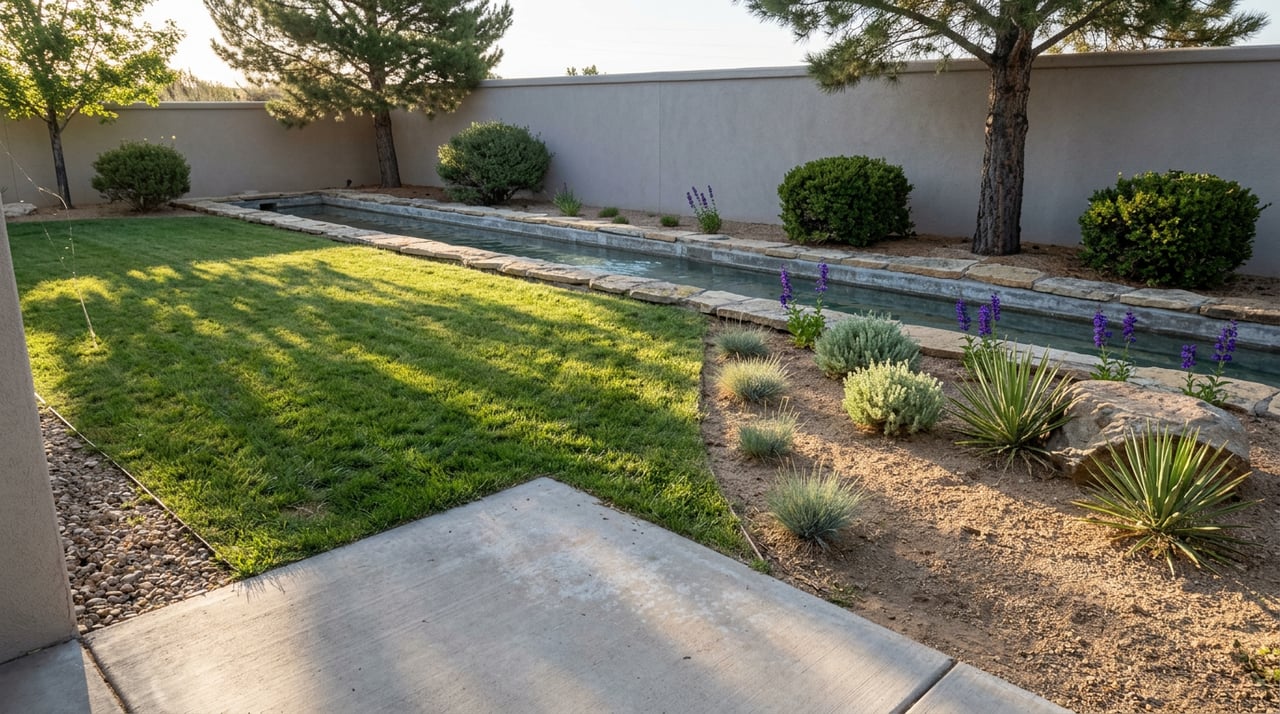
Redlands Irrigation Water Shares: What Buyers Should Verify
August 13, 2026
August 13, 2026
"The small steps are going to matter. I mean, the news is coming down. It's going to be a really bad drought. That means that the water is going to be scarce from what we're seeing."
That's Richard Bullen, project manager for Redlands Water and Power, talking to KJCT8 in late April 2026 about a drought season the company was already comparing to 2002, its previous worst benchmark. He wasn't talking about drinking water. He was talking about the water that keeps lawns, gardens, and mature trees alive across much of the Redlands, and it doesn't arrive through a city meter. It moves through a private ditch company that most buyers have never heard of until the week they close.
That's the part of the Redlands market a listing sheet won't tell you: whether a yard survives a dry August often has nothing to do with the water bill you'll pay a municipality, and everything to do with a share certificate in a company older than most of the subdivisions it serves.
Buyers relocating from a city with one water utility tend to assume irrigation works the way indoor plumbing does: pay the bill, get the water, repeat. In much of the Redlands, that's not the arrangement. Drinking water and indoor plumbing typically run through a municipal or district system. Watering the yard often runs through something else entirely, a mutual ditch company that predates the neighborhood, owned collectively by the people who hold shares in it.
Redlands Water and Power Company (RWP) is the largest of these in the area. Smaller shareholder-run systems, like the Redlands Village Ditch Company (RVDC), take water from RWP's canals and distribute it further into individual subdivisions. Other parts of the Grand Valley are served by entirely separate outfits, including the Grand Valley Irrigation Company and the Grand Valley Drainage District, which is one more reason to confirm the specific system attached to a specific parcel rather than assume it based on the neighborhood's reputation.
RWP draws its water from a diversion dam on the Gunnison River and moves it through a system the company describes on its own site as serving about 4,500 acres through 26 miles of ditches, diverting up to 750 cubic feet per second for irrigation and hydroelectric power. From there, smaller companies like RVDC carry it the rest of the way. RVDC's own materials describe a delivery ditch running roughly eleven miles from a headgate south of Highway 340 near Blevins Road, lifting water 127.5 feet before it ever reaches a homeowner's valve.
Ownership of that water isn't attached to a property the way a public water main is. It's attached to a share. Some Redlands homes carry ditch shares that transfer directly with the deed. Others sit inside an HOA that holds the shares collectively and bills residents through dues. Either way, the number of shares tied to a parcel, and whether that account is paid up, is a detail a buyer has to ask for by name. It rarely shows up on a standard listing.
A ditch running along the back of a lot isn't just scenery. It's a recorded private easement, and the company that owns it has real authority over what happens near it. RWP's own shareholder FAQ states that structures or plantings within 25 feet of a canal or ditch are typically prohibited, on both sides. RVDC goes further, warning shareholders in writing that any permanent construction placed inside an easement is not the company's responsibility to protect or restore once maintenance work requires digging it up.
For anyone planning a fence, a shed, an addition, or a new patio near visible ditch infrastructure, that's worth confirming with the ditch company before plans get drawn, not after a permit is pulled. It's the kind of site-specific check that pays off long before framing starts.
| Municipal or domestic water | Ditch company irrigation water | |
|---|---|---|
| Owned by | City or water district | Private mutual company (RWP, RVDC, and similar) |
| Used for | Drinking, plumbing, indoor use | Lawns, gardens, trees, some ponds |
| Governed by | Public rate structure and code | Company bylaws and shareholder standing |
| In a shortage | Publicly posted restrictions | Board discretion, including reduced or paused delivery |
RVDC's posted assessment for the 2026 season is $285 per share, due each spring. That fee funds delivery from RWP's system into RVDC's lateral lines, plus a ditch rider's salary, insurance, bookkeeping, and a maintenance reserve, according to the company's own FAQ. It's separate from property taxes and separate from any HOA dues.
It also doesn't cover everything. RVDC's FAQ states plainly that once water crosses from the shared lateral line into a homeowner's individual system, pumps, filters, valves, and sprinklers become the shareholder's own responsibility, not the company's. And the company has been direct about a less comfortable fact: only shareholders current on their assessments retain the legal right to use canal water under the bylaws, and the board has acknowledged collecting roughly 87 percent of a given year's assessments, with the remainder carried forward as arrears. For a buyer, confirming a seller's account is paid in full isn't a courtesy. It's a condition of actually getting water the first season of ownership.
The spring 2026 conservation push wasn't a one-off. The Grand Junction Sentinel reported that RWP's notice went out to 1,117 shareholders, asking them to limit lawn watering to one or two times a week, only between 9 p.m. and 8 a.m. The company's language at the time was clear that restrictions weren't optional forever: it was a matter of when, not whether, mandatory measures would follow if voluntary compliance fell short.
That discretion isn't new to a drought year. RWP's shareholder FAQ states that the company may refuse to deliver water through any segment of the system that hasn't reliably carried water for a substantial period, as determined by the board in its sole and absolute discretion. In other words, a ditch share is a right to request water administered by a private board, not a contractual guarantee of a fixed volume every summer. Most years that distinction doesn't matter. In a year like 2026, it's the whole story.
None of this makes a Redlands property a poor choice. It means the due diligence looks different here than it does in a subdivision on straightforward city water, and the difference is worth understanding before you're under contract, not after your first dry August.
Does every home in the Redlands rely on ditch water? No. Some newer developments and parcels closer to Grand Junction proper irrigate through other arrangements or don't carry ditch shares at all. Share status is parcel specific, not a given based on the neighborhood's name.
Is ditch water safe to drink? No. It's kept separate from a home's domestic water supply, which typically comes through a municipal or public provider, not through the irrigation canals.
What happens if a ditch company can't deliver a shareholder's full amount? Companies like RWP have relied on voluntary steps first, including scheduled watering windows, before considering more restrictive measures, based on the company's own April 2026 notice. Bylaws generally leave delivery during a shortage to the board's judgment rather than a fixed guarantee.
If you're looking at a property in the Redlands and want someone to sort out shares, easements, and assessment history before you're locked into a contract, that's exactly the kind of groundwork Kelley and Dane like to handle early. Dane's background in construction management means easement questions get answered before a shovel goes in the ground, not after. Work with Kelley & Dane to start your Grand Valley search.
Stay up to date on the latest real estate trends.
Blog
A local look at the lifestyle, community, and livability that set Fruita apart
Blog
Life with three little boys is naturally a bit wild.
Blog
A family's dream cabin on the Grand Mesa becomes a reality.
We live, work, and serve in the community we love. Our deep market knowledge means smarter pricing, stronger offers, and confident decisions.
THE GRIFFIN TEAM
COLDWELL BANKER DISTINCTIVE PROPERTIES
Agent phone: 970-589-6555
Office Phone: 970-243-0456
131 N. 6th Street Grand Junction, CO 81501